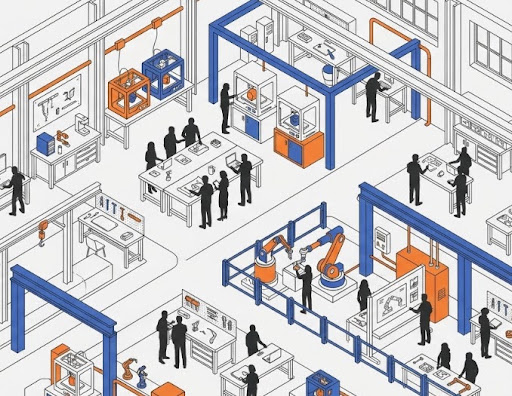
Mandelia is building out general infrastructure
(SaaS + Facilities & Resources) to commoditize the full AI Hardware Development lifecycle.
From advanced localized and cloud AI integration to physical prototypes & product scale.
3D Projection
Facilities Automation
Unison Actuation
Not built with Mandelia, these are examples of where we’re headed. These demos are provided by instagram Creators justelectronicx, dfifty, and makemindzz.
Mandelia is enabling anyone to build projects exactly like these in minutes/hours for $10-$100.
Mandelia is enabling anyone to build projects exactly like these in minutes/hours for $10-$100.
Kids/STEM
Hobbyist / Prosumer
Entrepreneurs
Solo-dev
Agencies
Enterprise Teams
Without Mandelia
Technically feasible, but:
- Requires time and patience most people don’t have.
- Are inaccessible to broad audiences.
- Require significant financial investment before prototype.
- Tutorials are bespoke/singular, not general dev knowledge.
- Tutorials aren’t your direct idea or need.
- Tutorials don’t help you productize your idea.
- Must learn nuance across AI inference models to properly downselect.
- Must do many tutorials across projects to build from scratch.
- Must dedicate personal space (kitchen, garage, etc.) to explore ideas.
With Mandelia
Manny - Your firmware as a service (FaaS) agent
- No Code, for devices: No claude, cursor, replit, or code required
- Rapid Prototyping: Deploy in minutes via proprietary write/compile/flash flows.
- Personalized Guidance: Support from architecture to product marketing.
- AI Integration: We pick the right AI models for your project and integrate them automatically - local 2 cloud
Mandelia Labs
- Risk-Free Testing: Tinker with premium hardware (>$5000) while investing <$100.
- Community: Real people, inspiration, and help in a dedicated space.
Mandelia Net:
E2E supply chain support
- RFQ generation: Manny splits up the work appropriately
- technical reqts generation: Manny knows how to convey your needs to suppliers
- Manny Communicates for you across our professional network.
Manny navigates Mandelia Net for you to mature your prototype into a product